

If your nonprofit is only sending emails when it is time to ask for money, you are leaving donors — and dollars — on the table.
Email remains the single most preferred communication channel for donors. According to the Neon One Nonprofit Email Report, 48% of donors say email is how they want to hear from the organizations they support — more than double the next closest channel (direct mail at 21%). And 33% of donors say email is the tool that most inspires them to give, ahead of social media, websites, and print combined (2025 Online Donor Feedback Survey).
Yet despite these numbers, many charities still treat email as an afterthought. They send the occasional newsletter or year-end appeal and wonder why engagement is low. The organizations that get email right are the ones raising more, retaining more, and building real relationships with their supporters.
Here is how to be one of them.
The Numbers That Should Change How You Think About Email
Before diving into strategy, it is worth understanding just how powerful email is for the nonprofit sector — and where most organizations fall short.
Nonprofits have an average email open rate of 28.59% and a click rate of 3.29% (Neon One), significantly outperforming the for-profit average of 21.5% (Campaign Monitor). Mailchimp's benchmarks put the nonprofit open rate even higher at 40.04% (Mailchimp). People genuinely want to hear from charities they care about.
On the revenue side, the average nonprofit raises $1.11 per email contact per year — and for small nonprofits, that figure jumps to $6.15 per contact (Neon One). For every 1,000 fundraising emails sent, nonprofits raised $58 in 2024 (M+R Benchmarks).
But there is a warning sign in the data: email accounted for 11% of all online revenue in 2024, down from 14% in 2023, even as nonprofits sent 9% more email volume (M+R Benchmarks). More emails, less return. That is not a channel problem — it is a strategy problem.
Why Most Nonprofit Emails Underperform
If your emails are generating low engagement, the cause is almost always one of these four issues:
- No welcome series. Research shows that 74% of new donors expect a welcome email after giving, yet only 57% of nonprofits actually send one (TrueSense Marketing). That gap between expectation and reality is where first-time donors start to disengage.
- No segmentation. Sending the same email to every contact on your list is the fastest way to increase unsubscribes. Donors at different stages — new, active, lapsed, major — need different messages, different tones, and different asks.
- Too many asks, not enough value. If donors only hear from you when you need money, they will tune out. The best-performing nonprofits balance fundraising appeals with impact stories, updates, and genuine engagement.
- Neglected list hygiene. Only 35% of nonprofits regularly delete unengaged subscribers (Nonprofit Tech for Good). A bloated list with inactive contacts drags down your open rates, hurts deliverability, and distorts your performance data.
5 Steps to Build an Email Strategy That Actually Works
1. Start With a Welcome Series (It Is Your Highest-Impact Opportunity)

Welcome emails have an average open rate of 80% (Mailmodo) — compared to roughly 29% for regular nonprofit emails. No other email you send will get this much attention.
A strong welcome series for new donors typically includes three to five emails over the first 30 days:
- Immediate thank-you and receipt — Sent within minutes. Confirm the gift, provide a tax receipt, and express genuine gratitude.
- Impact story (within one week) — Show what donations like theirs have accomplished. Use a specific example, a real number, and ideally a photo or quote from a beneficiary.
- About your organization (week two) — Share your mission, your team, and what makes your work different. Help the donor understand the community they have joined.
- Survey or feedback request (week three) — Ask what causes they care about, how they prefer to be contacted, and what inspired them to give. This data fuels future segmentation.
- Second gift invitation (around day 30) — Research shows donors are most receptive to a second ask within the first 30 days (NonProfit PRO). Position it as an opportunity to continue the impact, not as a demand.
How to get started: Most CRM and email platforms support automated sequences. Set up a basic three-email welcome series — even a simple one dramatically outperforms doing nothing.
2. Segment Your List (Even Basic Segmentation Makes a Difference)

Organizations implementing segmentation report 20 to 30% higher donation conversion rates and 15 to 25% increases in average gift size (Robly). Yet many charities still send every email to their entire list.
Start with these four fundamental segments:
- New donors (first gift in the past 90 days) — Prioritize relationship-building and impact stories.
- Active donors (gave within the past 12 months) — Share program updates and provide opportunities for deeper engagement.
- Lapsed donors (no gift in 12+ months) — Focus on re-engagement, not immediate asks.
- Monthly donors — Recognize their ongoing commitment with exclusive updates and milestone celebrations.
Personalized subject lines alone boost open rates by 26% (Campaign Monitor), and personalized calls to action convert 202% better than generic ones (HubSpot).
How to get started: Use your CRM's tagging and filtering capabilities to create these four segments. Then customize at minimum the subject line and opening paragraph for each group.
3. Get the Frequency Right
Nonprofits sent an average of 62 emails per subscriber in 2024 — more than one per week (M+R Benchmarks). For large organizations with diverse programming, that can work. For a small charity, it is likely too much.
The right frequency depends on your audience and content capacity. According to the 2025 Nonprofit Tech for Good Survey, the most common cadences are monthly (45% of nonprofits), quarterly (24%), and weekly (13%).
The key principle: send only when you have something worth reading. A well-crafted monthly email will outperform four forgettable weekly ones every time. If open rates start declining or unsubscribes tick up, it is a signal to send less frequently, not more.
How to get started: Commit to a consistent monthly email with one impact story, one organizational update, and one light call to action. Track open rates and unsubscribes to calibrate from there.
4. Design for Mobile First
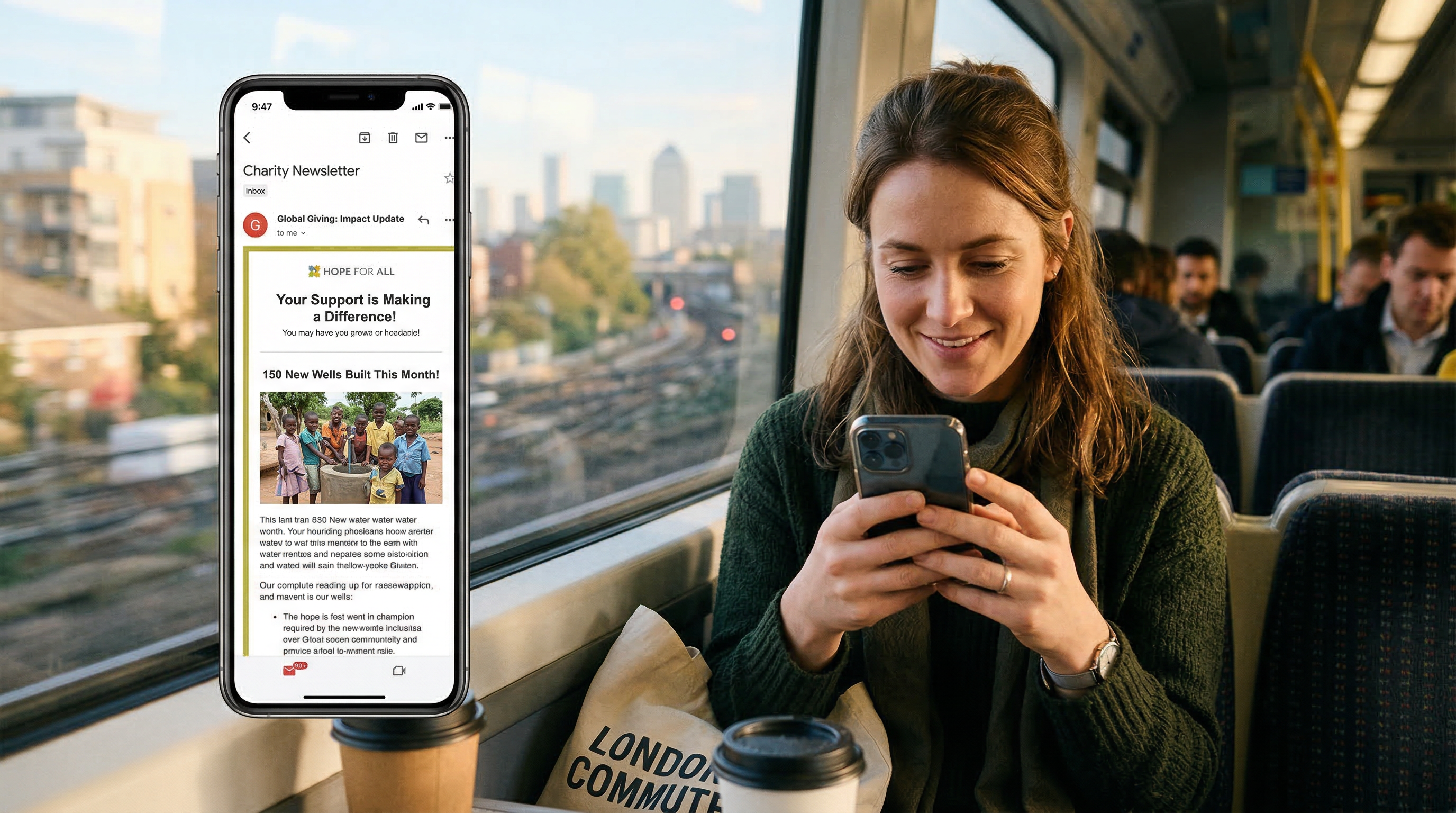
53% of email is now opened on a mobile device (Campaign Monitor). If your email is not designed for a phone screen, it is likely to be deleted in under three seconds — and as many as 15% of users will unsubscribe from emails that do not render well on mobile.
Mobile-friendly email design means:
- Single-column layout — No side-by-side content that requires horizontal scrolling.
- Large, tappable buttons — Call-to-action buttons should be at least 44 pixels tall.
- Short paragraphs and clear headings — Mobile readers scan rather than read line by line.
- Optimized images — Compressed files that load quickly on cellular connections.
- Preheader text — The preview text that appears alongside the subject line in a mobile inbox. Write it intentionally rather than letting your email client auto-pull the first sentence.
How to get started: Send yourself a test email and open it on your phone before every campaign. If you have to pinch and zoom, it needs work.
5. Clean Your List Regularly
A healthy email list is not the biggest list — it is the most engaged one. With 9% of subscribers unsubscribing and 7% becoming non-deliverable due to bouncing in 2024 alone (M+R Benchmarks), list decay is constant.
Regular list maintenance means:
- Removing hard bounces immediately after each send.
- Flagging subscribers who have not opened an email in six months.
- Running a re-engagement campaign for inactive contacts before removing them.
- Monitoring your unsubscribe rate (anything above 0.5% per send is a red flag).
Clean lists improve deliverability, which means more of your emails actually reach inboxes. They also give you accurate engagement data so you can make informed decisions about content and frequency.
How to get started: Schedule a quarterly list audit. Review contacts who have not engaged in six or more months. Send a re-engagement email, and remove anyone who does not respond within 30 days.
A Note for Canadian Charities
Canadian nonprofits operate under Canada's Anti-Spam Legislation (CASL), which requires explicit or implied consent before sending commercial electronic messages — including fundraising emails. While registered charities have certain exemptions for donors and members, it is still best practice to maintain clear opt-in records and provide easy unsubscribe options in every email.
The 2025 Canadian Direct Mail Benchmarks found that multi-channel donors — those who engage through both mail and digital — gave an average of $182 per gift, compared to $112 for mail-only donors. Email is not a replacement for direct mail in Canada, but it is a critical complement. Charities that integrate email with their existing mail and receipting workflows see stronger results across both channels.
The Bottom Line
Email is not a dying channel. It is the channel where your donors already are, where they prefer to hear from you, and where they are most likely to be inspired to give.
But sending more email is not the answer. Sending smarter email is. That means welcoming new donors promptly, segmenting your audience, providing genuine value between asks, and maintaining a clean and healthy list.
The good news for small charities: you do not need a marketing team or an enterprise email platform to do this well. A solid CRM with email and automation capabilities, a consistent schedule, and a commitment to treating every email as a relationship touchpoint — that is what separates the organizations that thrive from the ones that get ignored.
Jordan at CharityPack writes about nonprofit technology, marketing strategy, and digital communications for charitable organizations. CharityPack is a CRM built for Canadian and U.S. charities to manage donors, volunteers, and communications in one place.